Showing posts with label Metro Construction. Show all posts

Thursday, 29 September 2022

Importance of Diaphragm Walls in Metros – A Case Study

Diaphragm Walls in Metros

India’s first metro rail started back in 1984 in Kolkata (then Calcutta), West Bengal . Ever since, India has seen a rapid expansion of metro rail in various cities, with Delhi leading, and other cities catching up like Ahmedabad, Bengaluru, Gurugram, Kanpur, Kochi, Lucknow, Mumbai and now even Agra.

India being a country with densely populated cities, building metro railway lines and stations is nothing short of a challenge. Heritage Infraspace Pvt Limited has assisted and provided metro diaphragm wall construction services to many metro contractors in India. Here, we break down the importance of diaphragm walls in the construction of metro railways, as an interesting case study.

Types of stations built by metro contractors in India

There are majorly two types of metro stations: elevated and underground stations.

An elevated metro railway station or elevated train station is a railway platform alongside the tracks above street level on a viaduct or other elevated structure, usually constructed from steel, cast iron, concrete, or bricks by metro contractors in India.

An underground metro railway station is where the platform is built multiple levels beneath the ground as deep basements. The metro rail tracks run parallel to these stations, with a bustling city above it.

Elevated railways are normally found in urban areas where there would otherwise be multiple level crossings. Usually, the tracks of elevated railways that run on steel viaducts can be seen from street level.

Underground metro stations are generally proposed in older, dense parts of the cities where roads are narrow and sharp turns do not allow elevated rail alignment without major demolitions.

Importance of diaphragm walls for underground metro stations

Diaphragm walls are sturdy underground structures that can act as a permanent structural wall. Diaphragm walls can be installed to deeper depths, which helps in building multi-basement stations.

Compared to construction of a station on an elevated metro corridor, underground metro diaphragm wall construction services require less temporary propping. The top-down construction method can be applied in building an underground metro railway station.

The diaphragm wall is a rigid structure, hence the ground movement induced by basement excavation for underground metro is lesser compared to usage of flexible retaining walls. Diaphragm walls act as a strong guide wall for the launching shaft for metro stations.

Challenges faced by HIPL Ground Team

A major challenge HIPL faces as a commercial construction company in India working on various underground metro projects is accurately/precisely identifying the quality of the soil. With urbanisation, soil quality cannot be determined with a single inspection, and as the excavation takes place, the teams come across various forms of soil, which affects the metro diaphragm wall construction to a great extent.

The other challenges are as below:

Metro construction area sees a lot of activity and hence securing an entire stretch for the excavation work and diverting the traffic is a challenge.

Transportation of various construction materials, utilities, machinery, etc. is a big challenge, as urban areas have constant and heavy flow of vehicular and foot traffic in congested spaces.

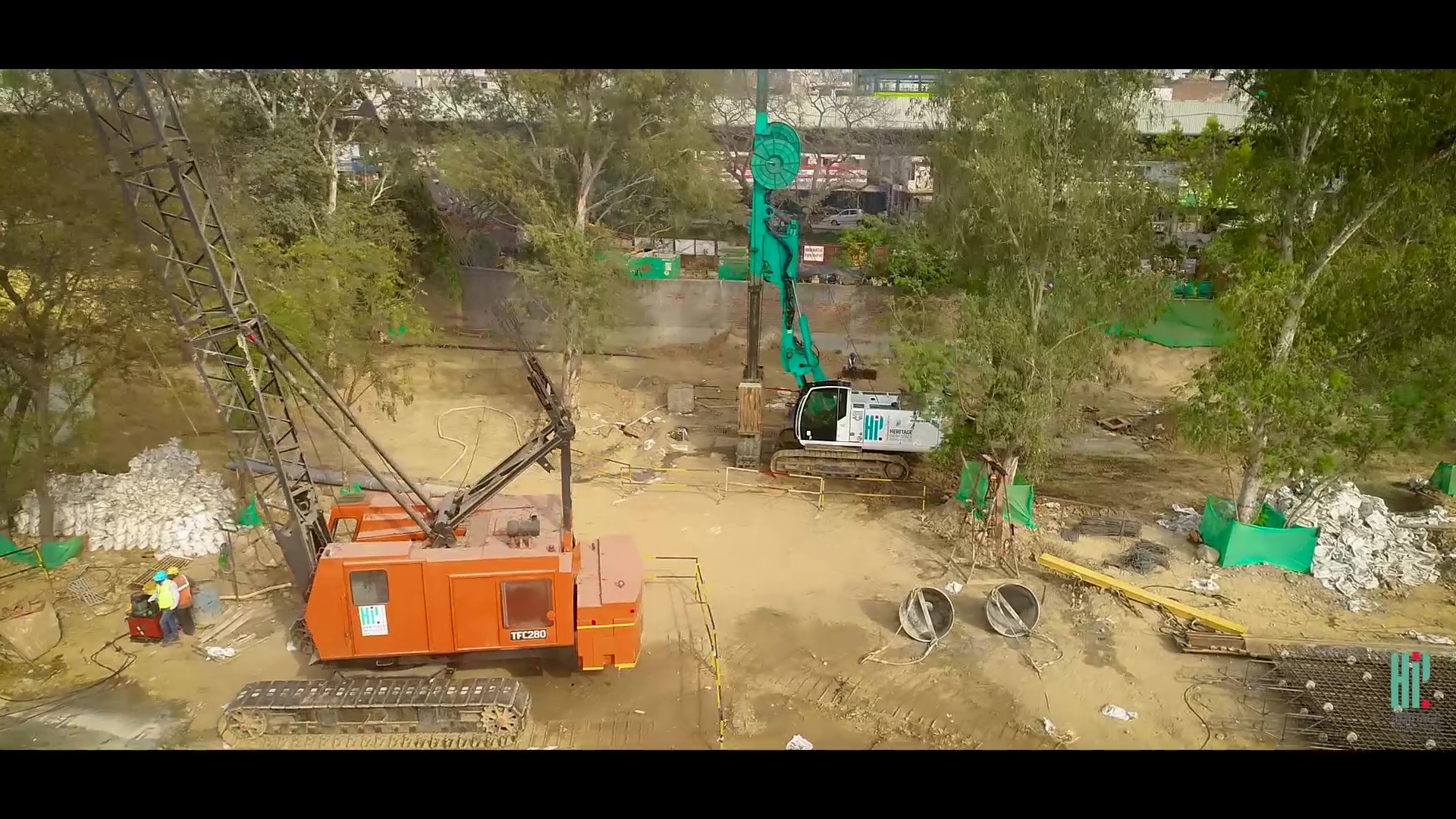
Continue reading

Tuesday, 7 June 2022

HIPL and Its Contribution to Modern Metro Construction in India

Delhi-metro

Metro Rail has changed the way people commute within cities in India. Constructing such a complex transit system in a populated country like India is a herculean task. And we at Heritage Infraspace Pvt. Ltd, as a leading construction company in India, take great pride in the fact that we’ve contributed towards the metro construction in India with our diaphragm wall technology, piling and shoring services.

HIPL has provided intelligent ground engineering solutions for various metro construction in India and have executed them with excellence in collaboration with multiple government departments and some of the top construction company in India.

Working with the best

Heritage Infraspace metro construction include the thriving Krishna Park station at Delhi Metro, the elevated station stretch of Kalamasherry-Muttam-Pulinchodu-Aluva for the Kochi Metro, the Bada Chauraha and Chunni Ganj stations of Kanpur Metro and the launching shaft for Ahmedabad Metro.

Delhi-Metro-Tunnel-Phase

HIPL worked with some of the biggest names like Larsen & Toubro on the Kochi and Ahmedabad Metro, Gulermak for the Kanpur Metro and Hindustan Construction Company for the Delhi Metro Project. While construction companies in India were the major project executioners, HIPL were awarded with the crucial task of diaphragm wall construction for deep basement underground metro stations.

The Kochi Metro was the first project awarded to HIPL, where we provided our piling services for the elevated stations, constructing 296 piles. HIPL was invited to work on this project when almost every major construction company in India refused to work on the site, majorly because it was close to the dumping yard, which ended up degrading the soil quality and it required some high level soil management and ground engineering to work on it.

Modern problems require modern solutions

Delhi-metro-1

Metros always run amidst the hustle and bustle of the modern cities today, hence the construction of underground stations require innovative engineering solutions with state of the art equipment to execute them perfectly. HIPL uses the top of the line machinery from its fleet for its metro projects, like the Jint SG 35 in Ahmedabad, Casagrande B125 for Delhi Metro and Casagrande B200 in Kanpur. Another crucial piece of machinery which we use regularly on our sites is the Ultrasonic Drilling Monitor, an intelligent utility device for complex civil engineering and foundation work. We sourced it from Koden in Japan, and use it to maintain the verticality of the construction, where every 10 meters the bore’s verticality is checked with a sensor, and precise measurement, display and recording of perpendicularity of drilled holes and the shapes of cross-sections.

Continue reading

Thursday, 12 May 2022

Everything You Need To Know About Building Concrete Diaphragm Walls

Building concrete diaphragm wall

Right from metro rail construction to new age super structures like towering residential and commercial complexes, building of concrete diaphragm wall has become a common practice and projects are now seeking only the best diaphragm wall company, like HIPL, to be building these D-Walls. But, what exactly is a diaphragm wall, and how does it help building structures? Here’s everything you need to know.

What is a concrete diaphragm wall?

Diaphragm walls or slurry walls are generally reinforced concrete walls, constructed in the ground using an under-slurry technique developed in Europe. This technique involves excavating a narrow trench that is kept full of an engineered fluid of slurry. This way, walls with thickness ranging between 300 mm to 1200 mm can be formed as deep as 45 metres underneath. Inclined rock or soil anchors are used for this purpose. Diaphragm walls are commonly used while constructing structures with deep basements in congested areas, as they can be installed in close proximity to the existing structures.

Previous history of diaphragm wall being used in construction in India

concrete diaphragm wall

The earliest recorded use of diaphragm wall technology is said to be during the excavations for the construction of Milan Metro in Italy back in the 1950s. In India, this technique can be traced back to the construction of metro rail stations and tunnels, Kolkata Metro being the first ones.

This is a civil engineering technique of construction, pioneered by Heritage Infraspace in deep basement diaphragm walls in India.

Now, in metro construction, D-walls ranging between 800 to 1200 mm are built. But while constructing deep basements for residential and commercial complexes, there are varying sizes used, they are as follows:

  • For a single basement construction, we build 300 mm diaphragm walls
  • For a double basement construction, we build a minimum 400 mm diaphragm wall
  • For a 3-basement construction, we build a minimum 500 mm diaphragm wall
  • And for a construction of 4-basement or more, we build diaphragm walls starting at 600 mms.

But here’s a crucial point to remember, all the above depends majorly on the soil strata. For a D-wall to do its job perfectly, the soil must not be loose. D-wall construction makes it cost effective compared to the other older, traditional methods like Piling. The major challenge with Piling, apart from being costly and time consuming, is that it doesn’t maintain the verticality.

Continue reading

Friday, 15 April 2022

Delhi Metro X HIPL: Changing the Way People Commute, With Metro Construction in India

Metro Construction India

Heritage Infraspace Pvt Limited (HIPL), as one of the best construction companies in India, has worked on many metro rail projects all over India, and one of its most prestigious projects has been the Delhi Metro projects. HIPL has had the opportunity to provide its services in the construction of the crucial metro station of Krishna Park Extension for the Delhi Metro Rail Corporation (DMRC).

Here’s a look into the observations made, challenges faced, and solutions provided for the metro construction in India.

HCC-VCCL Joint Venture for DMRC Project – The client

  • Delhi Metro Rail Corporation Limited (DMRC) is a mass rapid transit company run equally by the central government and the state government of Delhi. All the construction and operations of the Delhi Metro is managed by the Delhi Government.
  • The Delhi Metro is considered to be the largest and busiest metro rail system in the country. It is the second oldest after Kolkata Metro construction in India.
  • This project was a part of the joint venture of the HCC (Hindustan Construction Co. Ltd) and VCCL (Vensar Constructions Company Ltd), which was awarded to them in 2020.
  • HCC has been one of the major contractors for metro rail construction in India, and were the ones who also built the Kolkata Metro back in 1995

Projects awarded to HIPL for the Delhi’s Metro construction in India

Metro Rail Map

  • HIPL was contracted to work on Krishna Park Extension, an important metro station
  • HIPL provided their services in Diaphragm Wall Construction, a segment we are best-known for and have pioneered in India
  • HIPL worked in tandem with other prominent contractors and the state and central governments, who were leading and monitoring the projects’ progress.
  • The Krishna Nagar Extension was awarded to HIPL in 2020 as a part of the Metro Phase-4, where we worked under the HCC-VCCL JV.

Challenges in this project

  • Krishna Park is located in an area that sees a lot of activity. Which meant securing an entire stretch for the excavation work and diverting the traffic on to a different path.
  • Transporting various construction material, utilities, machinery, etc was a task on hand, given that both the location saw constant and heavy flow of vehicular and foot traffic in congested spaces.
  • Keeping up with the strict pollution control standards for construction in public spaces by the National Green Tribunal (NGT) and Pollution Control Board (PCB). This was important since Delhi is notorious for its poor quality of air during winters.
  • One of the biggest challenges with construction for the metro station is cutting down trees, which is highly frowned upon by the NGT and PCB.
  • Another huge challenge was to deal with the regular lockdowns imposed every time there was a spike in the Covid-19 spread during the work on Krishna Nagar Extension.
  • There was a tight deadline from the government, as both the areas were active locations and holding up daily activities for long construction projects would mean inconveniencing the residents.

Continue reading

Monday, 21 March 2022

How We Became the Leaders in Diaphragm Wall Construction in India

DiaphragmWall

Building strong foundations for a glorious future

Heritage Infraspace Pvt Ltd (HIPL) is an Ahmedabad-based award-winning, ISO 9001: 2015 accredited construction company in India with over a decade’s experience in diaphragm wall construction. We are pioneers of ground engineering solutions for commercial and residential construction projects In India, such as diaphragm wall in basement construction, as well as, deep foundation projects. HIPL also provides critical geotechnical solutions for leading metro construction companies in India, dam projects and subway systems.

HIPL was founded in March 2011, by Gagan Goswami, a civil engineer with a rich and extensive experience of over 16 years, working across construction projects in India and the Middle East, for companies such as ITD Cementation Ltd and Reliance Industries. He decided to start his own engineering construction company in India, without any financial backing, built entirely from the ground up.

HIPL Projects

What motivated Gagan to start HIPL was his observation that open excavation projects were replete with accidents, causing financial loss, but more importantly a loss of precious human life. Through his research and experience abroad he realised that both the quality of work and safety of workers was taken a lot more seriously abroad. So he decided to introduce some of this innovation in underground construction to India. Introducing diaphragm wall construction, a European method of constructing a slurry wall, while building basements for commercial and residential projects. Apart from safety, this also improved the timeline of constructing major projects. As the company grew, HIPL added other services such as piling, anchoring, waterproofing, RMC and more.

In all this, engineering excellence and continuous innovation remain the core values of the company. HIPL operates across 11 Indian states and more than 25 cities. We have completed over 300 projects, built 42 kilometres of diaphragm walls, and installed over 50,000 anchors, with a devoted team of over 450 of our Heritage family members.

Meet Gagan Goswami, our founder

Gagan Goswami

Mr. Gagan Goswami comes from a family of teachers in the small village of Gandhisagar in Madhya Pradesh’s Mandsaur region. He began his career as a training engineer, working on numerous projects around India. For four years, he worked as an independent consultant on building projects in Oman, Muscat, and Dubai, gaining international experience.

Upon his return to India, he formed HIPL with just 8 team members, and pioneered the use of diaphragm walls for deep basement construction as an important element of underground construction. Under his leadership, HIPL’s focus on worker’s safety, as well as, the use of new technology and machinery in all our projects has made us the leaders in this segment, which we have helped establish in India.

Continue reading

HIPL X L&T: A Journey of Pace & Modernity

Built by the top civil construction companies in India , modern superstructures depend on sophisticated and calculated geotechnical solutio...