Showing posts with label Construction Companies. Show all posts

Monday, 23 January 2023

Building Engineering Marvels with One of the Best in the Industry, One Foundation at a Time!

Building engineering marvels with one of the best in the industry, one foundation at a time!

As pioneers of smart geotechnical solutions like diaphragm wall construction, Heritage Infraspace Private Limited (HIPL) holds a legacy of providing a strong and dependable foundation for modern superstructures of India along with the top construction companies in India, and Shilp Group is a leading name among them.

With over 40+ residential and commercial projects, the Shilp group has trusted HIPL with the deep basement projects at signature locations in Ahmedabad.

Learn all about the projects, the challenges faced by HIPL and the solutions developed to positively counter them.

The Client: Shilp Group, builders of excellence.

A name synonymous with quality and integrity, Shilp group has been the master of modern infrastructure. Being among the top construction companies in Ahmedabad, it is known for innovating the real estate industry with its residential and commercial properties that run over 75 lakhs sq. ft.

With a heritage of 18 years, the Shilp group has been the obvious choice in real estate when it comes to creating comfortable, stylish and better living spaces on the foundation of trust, safety, innovation and premium quality.

These core values resonate with HIPL deeply and led to the successful completion of the multi-basement diaphragm wall construction for a few signature Shilp projects.

The Projects: Symbols of trust

From diaphragm walls in dams to the ones for deep basement construction, HIPL has successfully completed multiple projects that hold superstructures of the contemporary world. And with the Shilp group, HIPL has worked on the following projects:

Residential project
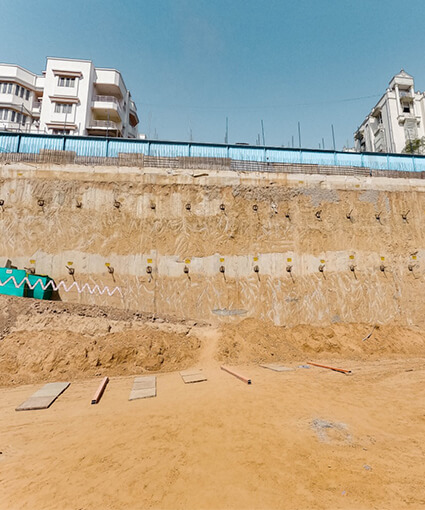
1. Shilp Serene

Located in the heart of S.P. ring road, Shilp Serene is a two-basement urban infrastructure with a unique locational advantage. HIPL started the project in the year 2022 and laid down a diaphragm wall (also called D-wall) with anchoring that runs around 13m deep and 220 m in width. As the top diaphragm wall construction company in India, it completed the project within a tenure of 2 months.

Commercial projects

1. Shilp Epitome

This superstructure stands as the epitome of excellence that every construction company in India aims for. With a 14m deep and 200m wide diaphragm wall and anchoring, this commercial property supports a 3-level basement built in around 2.5 months. This project was taken up by HIPL in the year 2018-19.

2. Shivalik Shilp 2

This megastructure has a 3-level basement constructed in the year 2017. HIPL laid down a diaphragm wall along with anchoring within 2.5 months. The diaphragm wall runs 18m deep and 250m wide supporting this 13-floored business hub.

3. Shilp Business Gateway

The Shilp Business Gateway project was taken over by HIPL, the top D-wall construction company in India. It built a 3-level basement with a 20m deep and 229m wide diaphragm wall in 2021 within 1.5 months.

Continue reading Building Engineering Marvels with One of the Best in the Industry, One Foundation at a Time!

Friday, 20 January 2023

Why Are D-Walls Becoming Extremely Popular with Construction Companies in India?

Diaphragm walls for top-down construction and deep basements have now become commonplace in the industry, and among construction companies in India. But how did D-Wall construction (another name for diaphragm walls) become a popular choice with civil engineers who are now confident to build towering superstructures with basements as deep as 5 levels?

Let us begin by understanding what a diaphragm wall is, how it is different from other traditional methods of ground engineering like Piling, and what makes it a desirable choice for deep basement construction.

What is a diaphragm wall?

Reinforced concrete walls built in the ground to provide support to the structure to be built above, and act as walls for the deep basement space to be built later, are known as diaphragm walls. They act as the cut-off walls for the excavated area of the site, provide a strong foundation to the surface and enclose the structure.

Piling – The traditional method of deep foundation construction

Piling is one of the oldest methods of building foundational bases for under-construction structures to transfer and manage the structural load on a deeper level. They are long, cylindrical structures that are made of either concrete, wood or steel.

There are two types of pile foundations used in building strong bases

1. End-bearing piles, that can transmit weight load directly to the deeper, stronger soil or the rock base of the site.

2. Friction piles, which transfers the load of the building to the soil across the full height of the pile, by friction.

Piling, a traditional method, is used when the structure above has heavy, concentrated loads and the spread footing won’t be able to bear the weight. So the building structure needs to bypass this layer and transfer the weight to the stronger base at depth.

While a diaphragm wall is constructed by excavating a narrow trench with a thickness ranging between 300 mm to 1200 mm, as deep as 45 metres underneath. It actually does the exact same job, and moreover, offers to act as a retaining wall for the basement, making the foundation stronger.

Yet, what makes construction companies in India choose diaphragm walls for basements?

Lower steel consumption

The cage walls made for diaphragm wall construction require lesser steel bars compared to constructing and inserting piles into the ground below. And in scenarios of unstable soil on the site, an additional casing is required on the piles, which may add an extra cost to the materials consumed.

Continue reading Why Are D-Walls Becoming Extremely Popular with Construction Companies in India?

Tuesday, 15 November 2022

Everything Starts With the Soil in Diaphragm Wall Construction

best construction companies in India

Understanding soil is a crucial part of building a diaphragm wall for deep basements. Civil engineers from some of the best construction companies in India will agree that for a project to proceed, it is vital to ensure that the soil on the construction site can take the load, withstand the pressure with time and not degrade the construction material used in the structure.

top civil construction companies in India

As one of the top civil construction companies in India, we have set standards in constructing diaphragm walls in almost all types of soil across the country and worldwide. Read on to know what our civil engineers look for in the ground they work with and the actions they take to ensure a strong foundation is laid for the diaphragm walls to last for the longest time.

Types of soil

A large country like India has different types of soil in different regions as per its climatic conditions and its exposure to various environmental elements like heat, snow, salinity, etc. Being among the leading construction companies in India and having worked all over the country, our engineers have come to define the types of soil below and how they affect deep basement construction:

– Sandy: In the north-western belt of the country, in states like Gujarat, Rajasthan and Haryana, the top soil strata have more sand in them and are drier because of the excessive exposure to heat. While excavating through them is easier, what’s challenging is ensuring the soil doesn’t collapse.

– Marshy: The coastal belt of India that stretches down south from Maharashtra to Andhra Pradesh and West Bengal, has a much marshier soil thanks to the high water table in the ground, proximity to the sea and the humid climate the regions have. The construction of the diaphragm wall in such soil conditions also involves shoring activities.

leading construction companies in India

– Sand with Silt: The central parts of the country, like Madhya Pradesh, Uttar Pradesh, Delhi and some parts of Gujarat have sandy soil, mixed with silt deposits. These occur from the various rivers flowing through these regions. Ahmedabad is one such city.

– Rocky/Gravel: The central and far northern regions of the country with mountain peaks have rocky strata with lots of gravel in their soil. Working in such conditions is a challenge, as engineers have to involve trench cutters to penetrate the layers to excavate further.

Challenges faced by the best construction companies in India

It is never a walk in the park when it comes to constructing a diaphragm wall for deep basements in a country like India, where the soil type changes with every state, cities are densely populated and the soil quality resultantly going down.

Continue reading

Friday, 14 October 2022

Bentonite to Polymer Slurry, the Sustainable Route to Building Reinforced Concrete Diaphragm Walls

building reinforced concrete diaphragm walls

Bentonite has been a crucial construction element in building reinforced concrete diaphragm walls for deep basement structures. But over the years, civil construction companies have started using polymer in their excavation fluids and slurry.

Read on to understand the importance of both the materials in constructing concrete diaphragm walls, the differences between them, and how polymer is growing as a more sustainable option in excavation activity while bentonite remains the foolproof back plan for civil engineers.

What are Bentonite and Polymer Slurries?

Bentonite clay is formed by the alteration and weathering of volcanic ash and is abundant in the clay mineral montmorillonite, which swells when mixed with water and possesses exchangeable irons on the surface that produce thixotropic suspensions. Typically mined in Rajasthan India, it is extensively used in diaphragm wall construction as an excavation fluid. Bentonite clay (in powder form) is combined with water in a colloidal mixer where the clay particles bond with one another to form a gel-like texture.

concrete diaphragm wall

The mixing process continues till the standard quality is achieved for the slurry.

Polymer slurry is prepared with the combination of water and hydrophilic superabsorbent polymers like polyethylene glycol, polyvinyl alcohol, or carboxymethylcellulose to form a thick, viscous mix. These water-soluble polymers have been used to stabilise deep excavations for reinforced concrete diaphragm wall trenches. When compared with conventional bentonite slurries,this engineered fluid is known to offer a variety of advantages including smaller site footprint and lesser environmental impact.

How is a bentonite slurry or polymer slurry prepared?

The slurry is prepared with the aim of attaining maximum hydration of bentonite clay or polymers. Hence, it must be slowly added into the mixing water to ensure all particles are irrigated and do not get lumped. Potable fresh water should be used in the mixing process to obtain the best results. Alongside this a chemical analysis, as listed out by the Indian Standard Code of Practice for Construction of Diaphragm Wall, must be conducted to ascertain the suitability of water. If needed, chemical treatment is given to the water before its usage.

civil construction company

The preparation of the slurry is done either in batches or in a continuous process, depending on the type of equipment used. The components are added in a high shear mixer through a simple venturi-hopper. To assure the dispersion of all the individual particles in the mixing water, the mixing equipment must generate sufficient shear. Once prepared, it is moved to storage tanks, and from there they are supplied to the excavation point, to be filled into the cavity of the soil. This entire process, including the testing is done on-site by the civil construction company assigned to build the diaphragm wall.

Continue reading

Wednesday, 20 July 2022

Kanpur Metro X HIPL: How We Helped Modernise Uttar Pradesh’s Public Transportation

top metro rail construction company in India

Heritage Infraspace Pvt Limited (HIPL), as a top metro rail construction company in India, has worked on many metro rail projects all over the country. In addition to being a part of Delhi Metro construction, one of our most prestigious projects has been the Kanpur Metro project. HIPL has had the opportunity to provide its services in the construction of the crucial metro stations of Bada Chauraha, Chunniganj, Jhakarkati and Transport Nagar for the Uttar Pradesh Metro Rail Corporation (UPMRC).

Here’s a look into the observations made, challenges faced, and solutions provided for this project, a part of the work we have done in the field of metro construction in India.

Working with Gülermak and AFCON, two prominent metro rail construction companies In India for the UPMRC Project

Uttar Pradesh Metro Rail Corporation is a joint venture company that operates the Lucknow Metro and Kanpur Metro. The other metro projects in the state are also under its ambit now such as Agra Metro, Meerut Metro, Varanasi Metro, Allahabad Metro, Gorakhpur Metro and Jhansi Metro.

Heritage Infraspace has worked on the UPMRC projects with two different metro rail construction companies in India. First with Gülermak, a Turkish construction company, known for rail transport, underground tunnels and metro stations.

The second time HIPL worked with Afcons Infrastructure Limited, a construction and engineering company based in Mumbai, Maharashtra, India that provides infrastructure services and is involved in the construction of infrastructure projects such as viaducts, flyovers, metros, bridges, etc.

The first metro rail construction project for UPMRC’s Kanpur Metro Project was awarded to HIPL in late 2021 along with Gülermak. And in early 2022, a second project was awarded to HIPL, to work with AFCON on metro rail construction.

Projects awarded to HIPL for the UP’s underground construction services in india

underground construction services in india

HIPL was contracted to work on Bada Chauraha & Chunniganj along with Gülermak in 2021. In 2022, HIPL was contracted a second time, to work on Jhakarkati & Transport Nagar stations. Work on these two projects are expected to get over by the end of August 2022.

HIPL provided their services in Diaphragm Wall Construction, a segment we have pioneered in India. No anchoring was required for these.

HIPL worked in tandem with other prominent contractors and the state and central governments, who were leading and monitoring the projects’ progress.

HIPL is in talks with UPMRC and other stakeholders to continue this relationship and work on the next set of stations too, as a top metro rail construction company in India.

Continue reading

Tuesday, 24 May 2022

HIPL x Hines: Building Futuristic Superstructures in Gurgaon

diaphragm wall construction

Heritage Infraspace Pvt Limited (HIPL) is known as the pioneers of diaphragm wall construction for deep basements in India. As one of the top construction companies in India, HIPL has worked on several residential and commercial projects collaborating with prominent names from the real estate industry. One such commercial complex project is the Adarshini real estate pvt ltd under Hines in Gurgaon.

Here’s a deep-dive into the observations made, challenges faced, and solutions provided during the construction phase of this project.

Adarshini & Hines – The client

Aadarshini Real Estate Developers Private Limited is a wholly-owned subsidiary of DLF Home Developers Limited, a part of the DLF (Delhi Land and Finance) Limited, one of the largest commercial and residential real estate construction companies in India.

Hines is a privately owned global real estate investment, development and management firm, with a presence in 285 cities in 28 countries and $90.3 billion of investment assets under management and more than 114.2 million square feet of assets for which Hines provides third-party property-level services.

Adarshini and Hines combined forces together to build an exceptional and modern commercial space in Gurgaon near the prominent Income Tax complex, to cater to the changing business landscape of India and its growing demand of workspaces that fulfil the requirements of the globally connected enterprises working round the clock.

Projects awarded to HIPL for this project

HIPL was first awarded with a project to build diaphragm walls, conduct anchoring for soil and the requisite excavation activities for the North Parcel in 2020. It took HIPL close to 1 year to complete this project.

Upon completion of the North Parcel, HIPL was awarded a similar project at South Parcel, commissioning them with the construction of diaphragm walls, soil anchoring and excavation.

The excavation activities for diaphragm wall projects are usually commissioned to a third party by the client, but in this case, HIPL was assigned with the excavation activities too, given that we had all the required equipment and manpower to execute it.

This is one of the biggest commercial projects HIPL has worked on. What makes this project unique, is that HIPL engineers used retractable anchors, something which was innovative and executed for the first time on a project of this scale and size.

Challenges in this project

project Challenges

One of the biggest technical challenges faced in this project was the size of the perimeter on which the diaphragm wall was to be built. Apart from that, ramping the soil was also challenging in terms of execution, given the depth of the project.

Supervision in every stage, in every aspect was extremely crucial. The lead engineers were present at the location, guiding, overseeing and ensuring perfection in execution at all the times.

This, because the first leg of the project was being conducted during the monsoons and precautions for the safety of the workers and neighbouring structures were important. One of the most important buildings next to the project site was the Income Tax complex.

Constant rains were a cause of worry. But our engineers and team of workers did everything required as a part of the monsoon precautions on the sides of the perimeter, to ensure all the water drains away and no water gets percolated behind the constructed diaphragm wall.

Continue reading

Friday, 15 April 2022

Delhi Metro X HIPL: Changing the Way People Commute, With Metro Construction in India

Metro Construction India

Heritage Infraspace Pvt Limited (HIPL), as one of the best construction companies in India, has worked on many metro rail projects all over India, and one of its most prestigious projects has been the Delhi Metro projects. HIPL has had the opportunity to provide its services in the construction of the crucial metro station of Krishna Park Extension for the Delhi Metro Rail Corporation (DMRC).

Here’s a look into the observations made, challenges faced, and solutions provided for the metro construction in India.

HCC-VCCL Joint Venture for DMRC Project – The client

  • Delhi Metro Rail Corporation Limited (DMRC) is a mass rapid transit company run equally by the central government and the state government of Delhi. All the construction and operations of the Delhi Metro is managed by the Delhi Government.
  • The Delhi Metro is considered to be the largest and busiest metro rail system in the country. It is the second oldest after Kolkata Metro construction in India.
  • This project was a part of the joint venture of the HCC (Hindustan Construction Co. Ltd) and VCCL (Vensar Constructions Company Ltd), which was awarded to them in 2020.
  • HCC has been one of the major contractors for metro rail construction in India, and were the ones who also built the Kolkata Metro back in 1995

Projects awarded to HIPL for the Delhi’s Metro construction in India

Metro Rail Map

  • HIPL was contracted to work on Krishna Park Extension, an important metro station
  • HIPL provided their services in Diaphragm Wall Construction, a segment we are best-known for and have pioneered in India
  • HIPL worked in tandem with other prominent contractors and the state and central governments, who were leading and monitoring the projects’ progress.
  • The Krishna Nagar Extension was awarded to HIPL in 2020 as a part of the Metro Phase-4, where we worked under the HCC-VCCL JV.

Challenges in this project

  • Krishna Park is located in an area that sees a lot of activity. Which meant securing an entire stretch for the excavation work and diverting the traffic on to a different path.
  • Transporting various construction material, utilities, machinery, etc was a task on hand, given that both the location saw constant and heavy flow of vehicular and foot traffic in congested spaces.
  • Keeping up with the strict pollution control standards for construction in public spaces by the National Green Tribunal (NGT) and Pollution Control Board (PCB). This was important since Delhi is notorious for its poor quality of air during winters.
  • One of the biggest challenges with construction for the metro station is cutting down trees, which is highly frowned upon by the NGT and PCB.
  • Another huge challenge was to deal with the regular lockdowns imposed every time there was a spike in the Covid-19 spread during the work on Krishna Nagar Extension.
  • There was a tight deadline from the government, as both the areas were active locations and holding up daily activities for long construction projects would mean inconveniencing the residents.

Continue reading

HIPL X L&T: A Journey of Pace & Modernity

Built by the top civil construction companies in India , modern superstructures depend on sophisticated and calculated geotechnical solutio...